
CHEXX in Kenya: Access, GRA Rules and Gambling Taxes
CHEXX currently lists Kenya among supported player locations, but access to the site and local operator licensing are separate questions. Kenya regulates online gambling under the Gambling Control Act, 2025, and operators that want to operate, sell or promote online gambling in Kenya are required to obtain the relevant licence from the Gambling Regulatory Authority of Kenya (GRA). CHEXX and Continent Gaming N.V. do not appear on the GRA’s published licensed-operators list referenced below. CHEXX instead has an active Curaçao Gaming Authority licence, OGL/2024/1332/0669.
Kenya’s current tax framework also matters independently of the licence question. The law sets a 5% excise duty on amounts deposited into a customer’s gaming wallet and a 5% withholding-tax rate on withdrawals made by punters. Those are statutory Kenya rules. They do not, by themselves, prove how CHEXX applies, collects or remits either charge in an individual account.
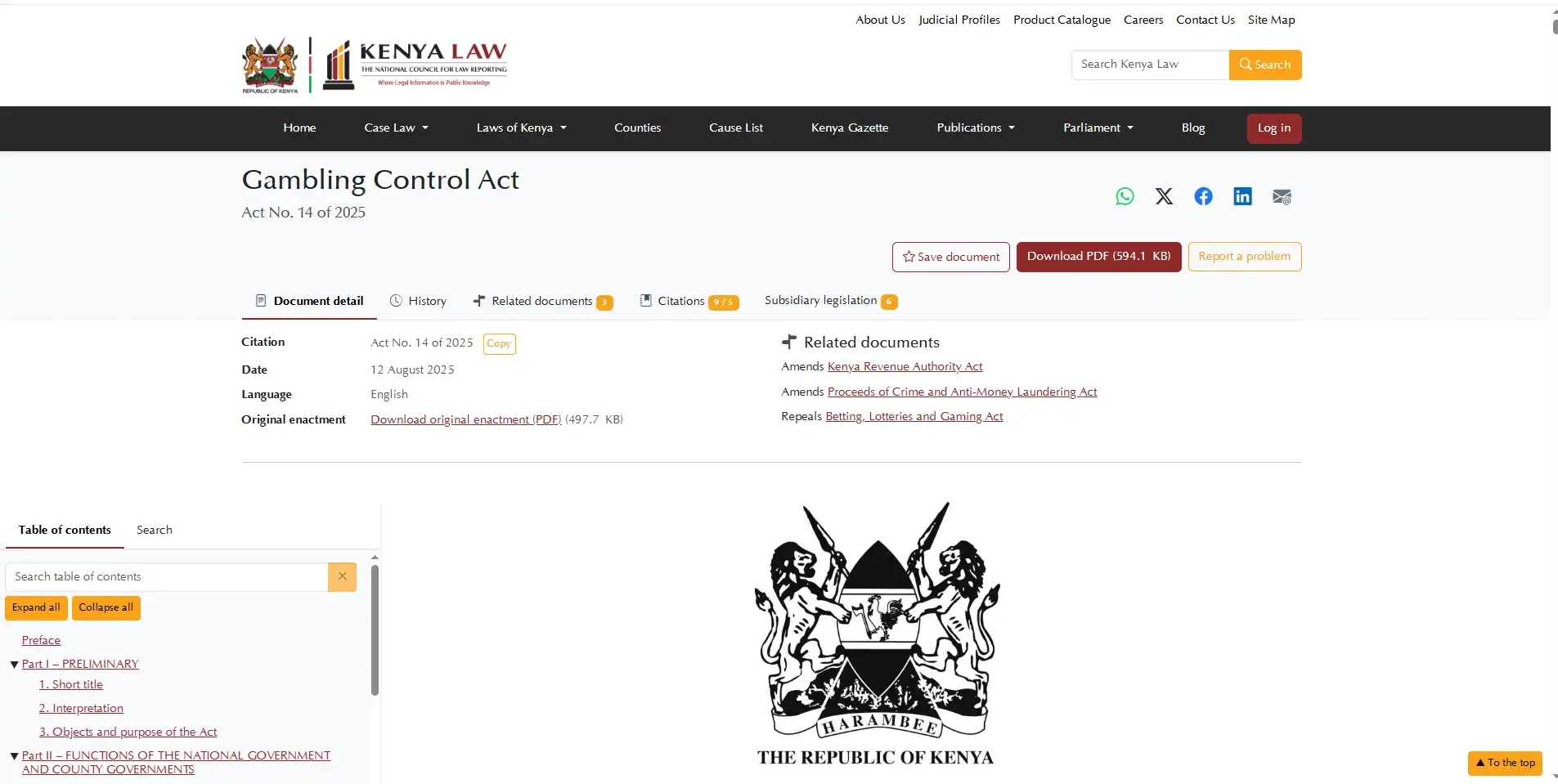
Table of Contents
- The short answer for a Kenyan CHEXX player
- CHEXX access is not the same as a Kenya licence
- What Kenya’s Gambling Control Act requires
- CHEXX’s licence is in Curaçao
- Kenya’s 5% gaming-wallet deposit excise
- Kenya’s 5% withholding tax on punter withdrawals
- What changed in the 2026 licensing dispute
- What a Kenyan reader can verify before using CHEXX
- How KYC fits into the Kenya question
- Describe CHEXX’s Kenya status with precise regulatory labels
The short answer for a Kenyan CHEXX player
The practical answer has three layers. First, CHEXX lists Kenya as available, and Kenya is not in its published list of seven restricted jurisdictions. Second, CHEXX’s published regulatory credential is a Curaçao Gaming Authority licence, not a Kenya licence. Third, Kenya’s own law requires local GRA licensing for online gambling activity directed at the Kenyan market.
Those statements should not be collapsed into a binary legal slogan. Access tells you whether the operator accepts a player. A Curaçao licence tells you which regulator licenses the CHEXX operator. Kenyan legislation tells you what local licensing rules apply to gambling businesses serving the market. Each answers a different question.
For broader operator and licence details, see CHEXX trust and safety. Kenyan access, local licensing and tax are separate from the operator’s Curaçao licence.
CHEXX access is not the same as a Kenya licence
CHEXX lists seven restricted jurisdictions: Belarus, Russia, Ukraine, the United States, Iran, North Korea and Myanmar. Kenya is not in that list, and its availability information includes Kenya. This is the basis for describing CHEXX as accepting players in Kenya.
That operational position does not create a Kenya-issued licence. The local regulator is the Gambling Regulatory Authority of Kenya. The published GRA licensed-operators list referenced here shows no Kenya licence for CHEXX or Continent Gaming N.V. The precise public conclusion is that no Kenya licence for CHEXX appears on the published list; that is not the same as a blanket legal verdict based only on the absence of a searchable entry.
This distinction is especially important for readers comparing offshore operators. A foreign licence can establish a real operator-regulator relationship in another jurisdiction, but it does not substitute for a local licence where Kenyan law requires one. It also does not automatically place an offshore player’s account inside Kenya-local consumer-protection or dispute-resolution arrangements.
The licence behind it: the trust page.
What Kenya’s Gambling Control Act requires
The Gambling Control Act, 2025 on Kenya Law established the current national framework and the Gambling Regulatory Authority of Kenya. Section 28 states the general rule that a person must not offer a gambling activity or service unless it is licensed under the Act. Section 67 then addresses online gambling specifically and requires a person seeking to operate, sell or promote online gambling in Kenya to apply to the Authority for an online bookmaker, online lottery or online casino licence.
The Act also deals directly with operators based outside Kenya. Section 79 provides that a foreign gambling operator can be issued an online gambling licence only after meeting specified Kenyan requirements, including registration and a registered physical address in Kenya, together with the requirements prescribed by the Authority. The same section makes clear that foreign operators serving Kenya fall within the local licensing framework rather than outside it.
For a CHEXX reader, the practical takeaway is simple: the local framework is not merely a rule for betting shops or Kenya-incorporated casinos. The Act expressly addresses online gambling and foreign-based operators. That is why a Curaçao licence and a Kenya GRA licence must be treated as distinct regulatory facts.
CHEXX’s licence is in Curaçao
A current check of the Curaçao Gaming Authority certificate portal confirms that chexx.bet is operated by Continent Gaming N.V. under licence OGL/2024/1332/0669. The certificate identifies the licence status as Active. The regulator’s certificate system links the CHEXX domain to the named operator and licence number.
The certificate should be read for exactly what it establishes. It establishes the CHEXX operator’s Curaçao licensing relationship. It does not establish a Kenya GRA licence, and a Curaçao licence does not override Kenyan licensing requirements. Readers can use the operator name and licence number as concrete identifiers when checking the brand independently.
Kenya’s 5% gaming-wallet deposit excise
Kenya changed the gaming excise framework through the Finance Act, 2025. The current Excise Duty Act states that excise duty on gaming is 5% of the amount deposited into a customer’s gaming wallet. The current Excise Duty Act on Kenya Law carries that 5% rate.
The wording matters. This is a tax on the amount deposited into a gaming wallet under the Kenyan statutory framework. It is not the older formulation based on amounts wagered or staked. For someone comparing deposit economics, that distinction can materially change the effective cost of funding a gaming account.
The statutory 5% rule does not establish whether CHEXX itself adds a line item, deducts it at the cashier or remits it on behalf of a Kenyan player. For CHEXX-specific funding methods and the site’s crypto-only cashier position, use the separate CHEXX payments.
Kenya’s 5% withholding tax on punter withdrawals
The current Income Tax Act uses a 5% withholding-tax rate for “withdrawals made by punters”. That wording is important because older commentary can still show outdated tax descriptions. The current statutory text uses 5%, so the present withdrawal-based formulation applies here.
Again, the statutory rate and an operator’s cashier workflow are different claims. The law confirms the Kenyan tax rate. It does not establish the calculation, withholding or remittance workflow used for a particular CHEXX withdrawal. A player evaluating payout mechanics should separate the legal tax rule from the operator’s own withdrawal procedure.
Current payout mechanics are covered in CHEXX withdrawals. Withdrawal minimums, fees and processing details should be checked there rather than mixed into the tax discussion.
What changed in the 2026 licensing dispute
Kenya’s licensing rules are also the subject of active litigation, which is why this part needs a date rather than a timeless statement. On 24 August 2026, Business Daily reported that the High Court had allowed the GRA to implement the contested Gambling Control (Licensing) Regulations, 2026, including collection of licensing fees, while the substantive challenge continues. The report makes clear that the substantive challenge remains pending rather than finally resolved.
As of 25 August 2026, the useful takeaway is not that the court case has finally settled the regulatory framework. It has not. The narrower point is that the licensing process and fee collection were allowed to proceed pending determination of the main case. Anyone relying on this information later should check the court position again because litigation can change the practical regulatory picture quickly.
For a live compliance decision, check the GRA website, Kenya Law and current court records rather than relying on third-party summaries alone.

What a Kenyan reader can verify before using CHEXX
| Question | Current position | Best next check |
|---|---|---|
| Does CHEXX accept Kenyan players? | Yes. CHEXX currently lists Kenya among supported player locations. | check again the operator’s current restricted-country terms before registering. |
| Does CHEXX have a Kenya GRA licence? | No Kenya licence for CHEXX appears on the published GRA licensed-operators list referenced here. | Check the current GRA licensing information and any public operator register. |
| What licence does CHEXX hold? | Curaçao Gaming Authority licence OGL/2024/1332/0669 for Continent Gaming N.V., shown as Active. | Open the CGA certificate portal and compare the domain, operator and licence number. |
| What is Kenya’s gaming deposit excise? | 5% of the amount deposited into a customer’s gaming wallet. | Check the current Excise Duty Act and KRA notices. |
| What is the current punter withdrawal withholding rate? | 5% under the current Income Tax Act wording. | Check the latest Income Tax Act text before relying on the rate for a tax decision. |
This checklist avoids a common error: treating a single signal as an answer to every question. An accessible account does not prove local licensing, an offshore licence does not prove Kenya-local protection, and a Kenyan tax statute does not prove a specific CHEXX cashier workflow.
How KYC fits into the Kenya question
Identity verification is relevant to account use, but it should not be used as a shortcut for the licensing analysis. For document and timing questions, see CHEXX KYC. Account verification does not replace the separate questions of access, licence jurisdiction, Kenya-local licensing and tax.
For a Kenyan reader, the practical point is that account verification, local operator licensing and tax are three separate layers. Passing KYC would not itself prove that an operator has a Kenya licence. Conversely, the absence of a Kenya licence on the published GRA list does not tell you what documents CHEXX will request from an individual account. Keeping those issues separate makes the compliance picture clearer.
The full picture is in our CHEXX review for Kenya.
Describe CHEXX’s Kenya status with precise regulatory labels
CHEXX currently lists Kenya among supported player locations. Its operator, Continent Gaming N.V., has an active Curaçao Gaming Authority licence under OGL/2024/1332/0669. Separately, Kenya’s Gambling Control Act requires GRA licensing for online gambling offered in Kenya and includes specific rules for foreign-based operators. No Kenya GRA licence for CHEXX appears on the published GRA licensed-operators list referenced here.
Kenya’s current tax framework sets 5% excise on amounts deposited into a gaming wallet and 5% withholding tax on withdrawals made by punters. Those statutory rates should not be presented as proof of how CHEXX processes a specific account transaction. The clean way to evaluate the brand is to keep access, licence jurisdiction, Kenya-local licensing, taxation and account mechanics as separate questions.
For a broader overview of the brand, return to the CHEXX Kenya review. Payment-specific questions and operator identity should be considered separately from the Kenya legal analysis.
 Lollipop Drop MultiMaxBulletproof Games
 Hot Hot FruitHabanero
 Wild PharaohSwintt
 Crazy MummyPascal Gaming
 The Boom SquadGenesis Gaming
 Trickstar SpinsYggdrasil Gaming
 The Book of AmaterasuMascot Gaming
 A Fistful of CoinsZeus Play
 Astro GemsMaverick
 Sweet BonbonellaSwintt
 ReactoonzPlay'n GO
 Fuzzy WuzzyPoggiPlay
 40 Super HotEGT Digital
 9 Arrows of OdysseusSpinOn
 Blackjack Surrender OriginsSurrender
 Premier Blackjack with Side BetsSide Bet
 Quantum Blackjack PlusMultiplier
 Turbo BlackjackFast-play
 European BlackjackMultihand
 Single Deck Blackjack GoldSingle Deck
 Double Exposure BlackjackDouble Exposure
 Classic BlackjackClassic
 Vegas Downtown Blackjack GoldGold Series
 American BlackjackClassic
 Multihand BlackjackMultihand
 Atlantic City BlackjackClassic
 Blackjack Lucky LadiesSide Bet
 Vegas Strip BlackjackClassic
 Perfect Pairs BlackjackSide Bet
 American RouletteClassic
 Mega Fire Blaze RouletteMultiplier
 Mini Roulette 3DMini
 Monopoly Roulette TycoonThemed
 Multifire RouletteMultiplier
 RouletteRelax Gaming
 Roca Riches RouletteThemed
 Lucky RouletteClassic
 Immortal Romance RouletteThemed
 European RouletteClassic
 Double Ball American RouletteDouble Ball
 Auto RouletteSwitch Studios
 Gold RouletteGold Series
 Quantum RouletteMultiplier
Published by the Chexx Casino team.